
Top Dog - Comparing Fractions Game | 10story Learning

Compare fractions

Beat target fractions by rolling dice. Use visual fraction bars to compare!
Top Dog Game Setup
Grades
3-5
Game Length
15 minutes
Game Type
Strategy, Competitive
  • Compare two fractions with different numerators and different denominators. (4.NF.A.2)
  • Explain why a fraction a/b is equivalent to a fraction (n × a)/(n × b). (4.NF.A.1)
1

Inside the Math

Traditional fraction instruction asks students to compare fractions abstractly using rules and algorithms. This game transforms comparison into a visual, spatial experience where students physically interact with fraction representations to understand magnitude.

The fraction bar model is the heart of this game—students fill in visual segments to see which fraction is larger, building intuitive understanding of fraction size.

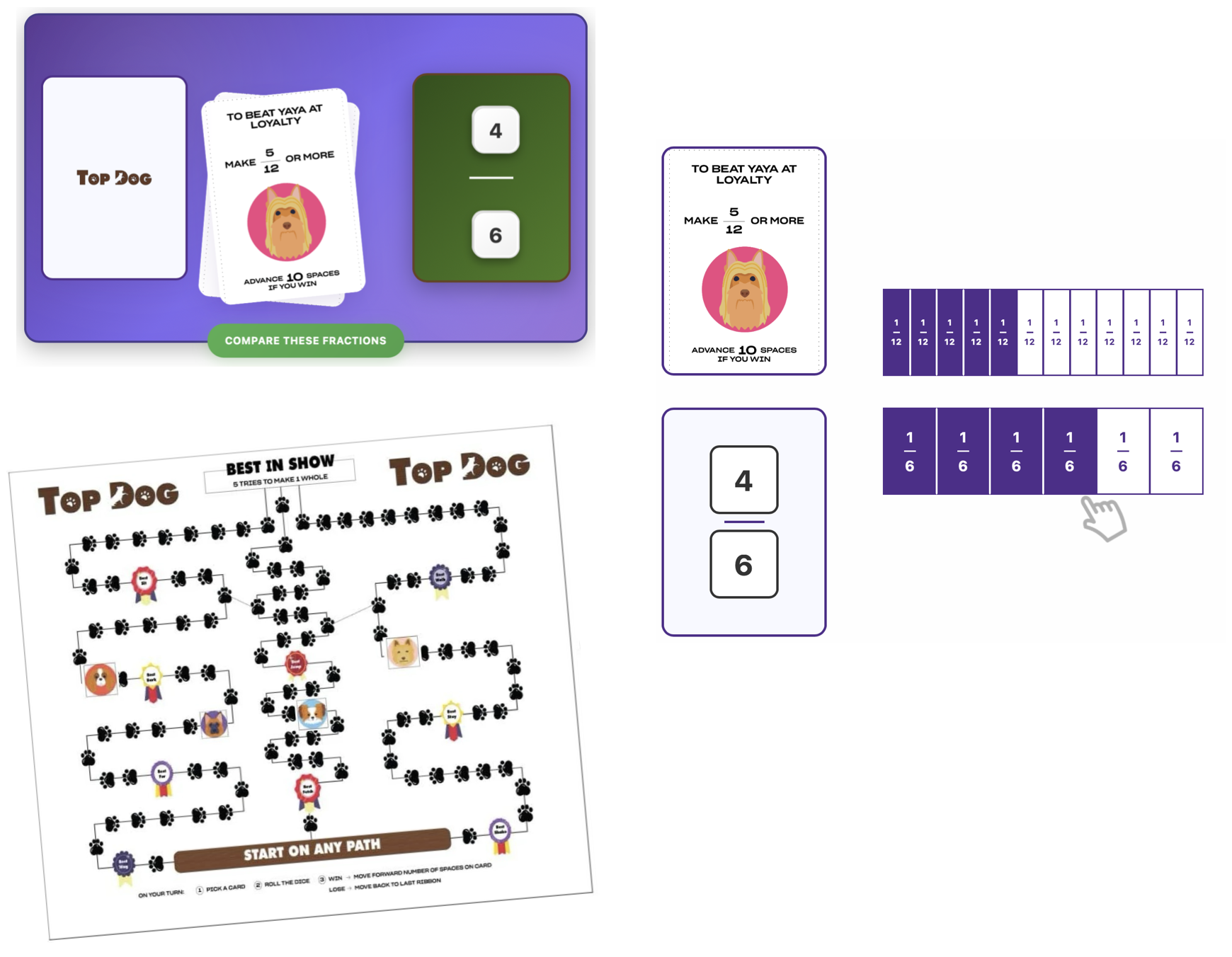
The core mechanic creates authentic mathematical reasoning: draw a challenge card showing a target fraction (like "Make 5/12 or more"), roll two dice, and decide which die becomes the numerator and which becomes the denominator. But the crucial learning happens next: students use the visual fraction bars to compare their rolled fraction to the target.

On screen, students see two rows of fraction bars—one representing their rolled fraction, one representing the target. By clicking to fill in segments, they physically construct visual models of both fractions. To compare 4/6 to 5/12, students don't calculate—they fill in 4 out of 6 segments in one bar, fill in 5 out of 12 segments in another bar, and see immediately which takes up more space.

This spatial interaction creates embodied understanding of fraction magnitude. Students aren't following rules about common denominators or cross-multiplication—they're experiencing fractions as visual quantities that can be directly compared through area representation.

The visual model makes equivalent fractions obvious. When students fill in 2/4 and 6/12, they see the exact same amount of space filled. When they fill in 3/6 and 1/2, the visual match reveals equivalence without needing to apply transformation rules. The fraction bars turn abstract equivalence into concrete visual identity.

Students must choose which die becomes numerator and which becomes denominator—but the fraction bars let them verify their choice visually before committing.

The decision-making process integrates prediction and verification. When a student rolls 4 and 6 and needs to beat 5/12, they might think "6/4 seems bigger than 4/6." But they can test this hypothesis by filling in the fraction bars. Filling in 6 out of 4 segments reveals a fraction greater than 1 whole, while filling in 4 out of 6 segments shows roughly two-thirds. This immediate visual feedback either confirms their reasoning or reveals misconceptions.

The game makes fraction misconceptions visible through spatial representation. Students who believe "bigger denominators make bigger fractions" will fill in 2/6 and see it occupies less space than 6/2. Students who think fractions with larger numerators are always bigger will fill in 6/5 and 5/6 and discover that 6/5 actually represents more area. These aren't abstract corrections—they're visual contradictions students can see directly.

The fraction bar interface supports flexible thinking about equivalence and comparison. Students can represent the same fraction different ways (4/6 equals 2/3), can see benchmark fractions like 1/2 as reference points, and can reason about "how far from 1 whole" by seeing empty segments.

Reaching Best in Show requires rolling exactly 1 whole—meaning the numerator equals the denominator. With the fraction bars, students see 1 whole as complete coverage: filling in 3/3 or 5/5 fills every segment completely. This visual representation reinforces that any fraction with equal numerator and denominator represents the complete unit, making the equivalence of 2/2, 4/4, and 6/6 visually obvious.

2

Building Foundation for Mathematical Thinking

Understanding fractions requires transitioning from discrete counting to continuous quantity—one of the most challenging conceptual shifts in elementary mathematics. This game supports that transition through spatial reasoning and visual representation, helping students develop fraction sense through physical interaction with area models.

Filling in fraction bar segments transforms abstract symbols into concrete visual quantities—students experience fractions as amounts of space rather than number pairs.

The act of clicking to fill segments creates embodied learning. Students aren't passively viewing fractions—they're actively constructing them. To represent 4/6, students click four individual segments, experiencing the denominator as "how many pieces" and the numerator as "how many I'm taking." This physical construction builds part-whole understanding at a kinesthetic level.

Visual fraction bars develop spatial magnitude reasoning that underlies advanced mathematical thinking. When students see 7/8 filling nearly the complete bar while 3/4 leaves a larger gap, they're not calculating—they're perceiving relative size through area. This spatial intuition transfers to algebra, where understanding variable quantities and equation balancing relies on magnitude reasoning.

The fraction bar model makes benchmark thinking natural. Students see 1/2 as filling exactly half the space, making it an automatic reference point. They see 5/6 as "one piece away from whole" and 2/3 as "twice as much as 1/3"—building the relational reasoning that supports mental calculation.

When students fill in fraction bars for 3/6 and then fill in bars for 1/2, they discover visual equivalence directly. The bars show identical amounts of filled space. This concrete experience with equivalent fractions builds understanding that different symbols can represent the same quantity—a fundamental concept for algebraic thinking where 2x and x + x represent identical values.

Choosing dice arrangement creates strategic thinking: students must predict which arrangement creates a larger fraction, then verify using the visual model.

The decision between 4/6 and 6/4 requires hypothetical reasoning. Students must mentally predict outcomes before acting: "If I make this choice, will it beat the target?" Then they can test their prediction by filling in the bars. This prediction-verification cycle is core to scientific and mathematical thinking—forming hypotheses, testing them, and adjusting understanding based on evidence.

The visual model supports understanding fractions greater than 1. When students fill in 6/4, they discover they need more than one complete bar—they fill all four segments of the first bar and continue into a second bar. This spatial experience builds intuition that 6/4 = 1 whole + 2/4, connecting improper fractions to mixed number representations visually.

Students develop flexible representation skills by seeing the same fraction through multiple denominators. The bars let them represent 1/2 as 6/12, see 2/3 as 4/6, and recognize patterns in equivalent forms—building the foundation for rational number understanding.

The game develops estimation skills through repeated visual comparison. After filling many fraction bars, students begin predicting comparison outcomes before completing the visual model. They develop intuition about fraction size categories: fractions close to 0, close to 1/2, close to 1 whole, and greater than 1. This estimation ability—knowing approximate magnitude without precise calculation—is essential for mathematical problem-solving and scientific reasoning.

Understanding probability emerges through gameplay experience. Students notice they roll 1 whole (equal numerator and denominator) roughly one in six times. The visual model reinforces this: seeing 1/1, 2/2, 3/3, 4/4, 5/5, and 6/6 all fill the complete bar identically helps students recognize that six different dice combinations produce the same outcome—an early encounter with probabilistic thinking about equally likely events producing the same result.

3

In the Classroom

This game fits naturally into fraction units as practice following initial instruction. Students need conceptual introduction to fractions and visual models before playing—understanding that fractions represent parts of wholes and that area models show fraction magnitude. The game then provides extensive practice with visual comparison strategies.

The 15-minute format supports math centers, station rotations, and intervention time—providing concentrated visual practice without disrupting instructional flow.

Typical classroom implementation: After teaching fraction comparison using area models, introduce the game as practice. The game's rules are straightforward enough that students can play independently after one demonstration. Groups of 2-4 students work well—small enough that turns come frequently, large enough for discussion about visual strategies.

The competitive structure creates engagement automatically. Students want to win, so they care about making correct comparisons. This motivation is particularly powerful for students who find abstract fraction work unmotivating—the visual context gives them a concrete tool for reasoning about fraction relationships.

Advanced students develop efficient visual estimation strategies—quickly recognizing whether fractions are closer to 0, 1/2, or 1 whole without filling every segment. Struggling students fill in every segment carefully, using the complete visual model as scaffolded support while still fully participating.

Mathematical discourse emerges naturally around the visual model: When a student claims to have beaten the challenge fraction, other players often question: "Wait, did you fill in 4/6 correctly? Let me see." These peer challenges create authentic opportunities for justifying visual reasoning. Students must demonstrate their filled segments, count to verify, and defend their spatial comparisons.

The backward movement consequence when failing to beat a fraction adds productive pressure. Students learn to be strategic—sometimes choosing safer arrangements, other times taking risks. But the visual model gives them a way to verify before committing: they can fill in both possible arrangements and compare visually before deciding which to submit.

Observing how students use the fraction bars reveals their understanding: confident visual estimation indicates fluency, while careful segment-by-segment filling shows developing concepts.

Assessment through observation: While students play, observe their interaction with the visual model. Do they estimate fraction size from partially filled bars, or do they need to fill every segment before comparing? Do they recognize equivalent fractions visually (seeing 2/4 and 1/2 as matching)? Students who consistently misjudge which fractions are larger reveal they need more experience with spatial magnitude reasoning.

Common implementation patterns:

Math centers: The digital game works perfectly as a station in a fractions unit. Students rotate through the game center over several days, experiencing different challenge sequences and building fluency with the visual fraction bar interface.

Partner practice: Pairs of students can share a device, discussing their visual reasoning before filling segments. This collaborative approach increases mathematical talk about spatial representation: "Look, 4/6 fills more space than 5/12 because..."

Intervention groups: Small groups with adult facilitation can use the game as structured practice with the visual model. The adult can pause gameplay to ask clarifying questions: "How do you know 4/6 is bigger? Show me on the bars. What if we drew 5/12 on the same bars?" This turns gameplay into formative assessment with immediate visual feedback.

The digital interface makes the visual model accessible on any device—computers, tablets, or interactive whiteboards. The interactive filling mechanism gives immediate feedback, with segments changing color as students click, providing responsive visual learning.

The dog show theme provides low-stakes fun without trivializing the mathematics. Students enjoy the playful context—moving toward Best in Show, collecting award ribbons as checkpoints—while engaging with sophisticated spatial reasoning about fraction magnitude. The theme doesn't distract from learning; it enhances engagement.

Extension opportunities: Advanced students can try estimating comparison outcomes without filling all segments, developing mental visualization of fraction bars. Classes can discuss visual strategies: "How can you tell if a fraction is more than half without filling every segment?" Students might discover that filling just the first few segments often reveals which fraction is larger, leading to discussions about efficient visual estimation.

This game transforms abstract fraction comparison into visual, spatial practice where interactive area models make magnitude concrete. Students build spatial reasoning, develop visual comparison strategies, and strengthen magnitude understanding—all through hands-on interaction with fraction bar representations.