

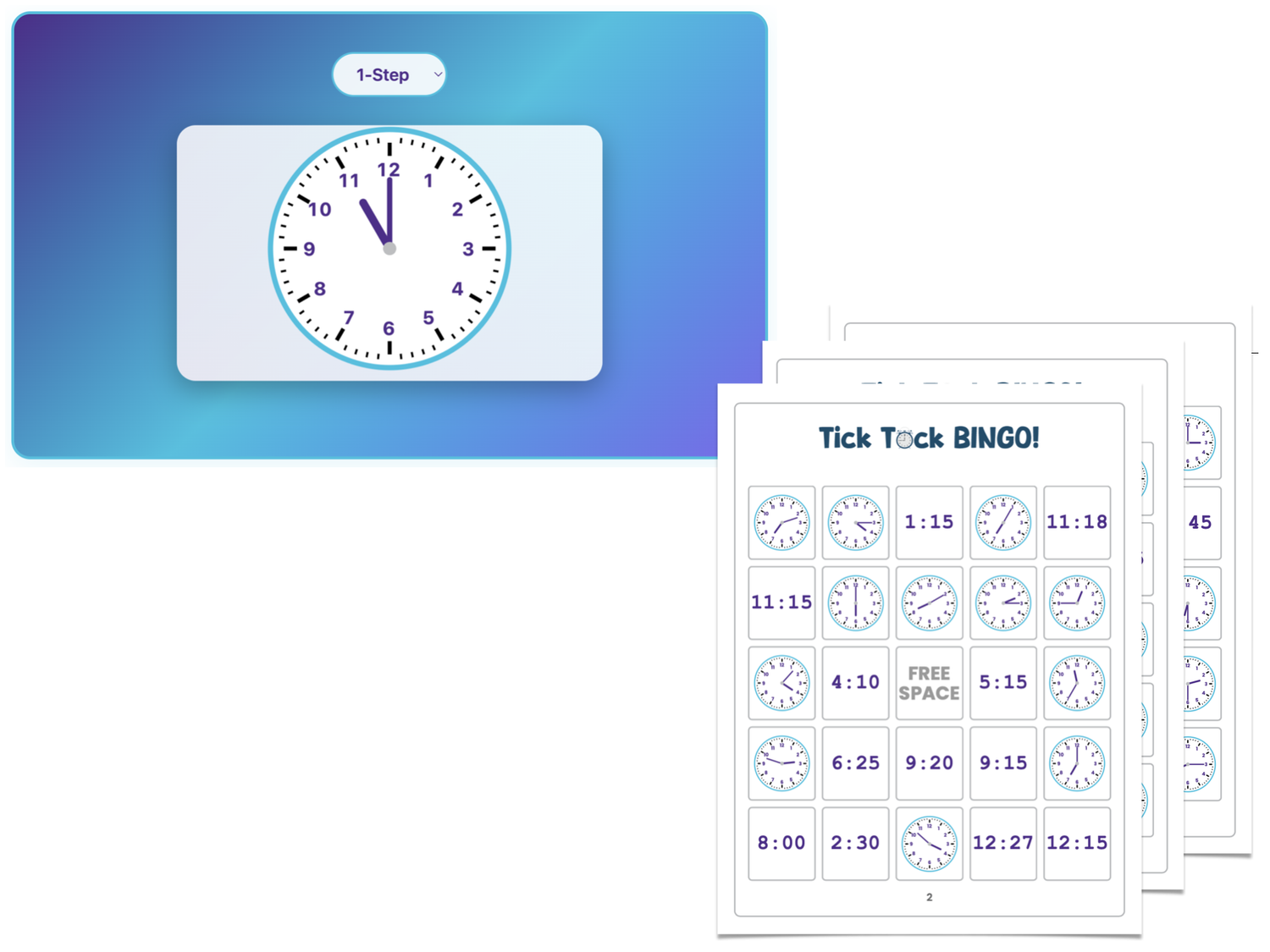
Most students learn to read analog clocks through worksheets that present isolated practice problems. Tick Tock Bingo transforms time-telling into a fast-paced matching game where attention to visual details determines competitive outcomes.
Each bingo card displays 24 different times in two formats simultaneously: traditional analog clock faces and digital time notation. When the caller announces "three fifteen," students must scan their card to locate that time in either format—recognizing both the circular clock showing 3:15 and the digital display reading "3:15."
This dual representation structure is mathematically significant. Students develop flexibility between symbolic and spatial formats rather than treating each as a separate skill. When students recognize that the clock face with the hour hand between 3 and 4 and the minute hand on 3 represents the same moment as "3:15," they build understanding of time as continuous measurement rather than memorizing arbitrary clock-reading procedures.
The competitive structure creates motivation to read clocks accurately and quickly. Students who develop strong visual pattern recognition gain advantage in gameplay, providing natural differentiation.
The challenge mode introduces times that don't fall on five-minute intervals—requiring students to read individual minute marks rather than counting by fives. This precision work develops understanding of how the minute hand moves continuously around the clock face, measuring elapsed time as a variable quantity rather than discrete jumps.
Students who confuse hour and minute hands notice immediately when their matches don't align with called times. Students who struggle with times like 12:45—reading it as "one forty-five" because the hour hand approaches 1—receive instant feedback during the verification phase. The game context makes these corrections feel like strategic adjustments rather than marked errors.