

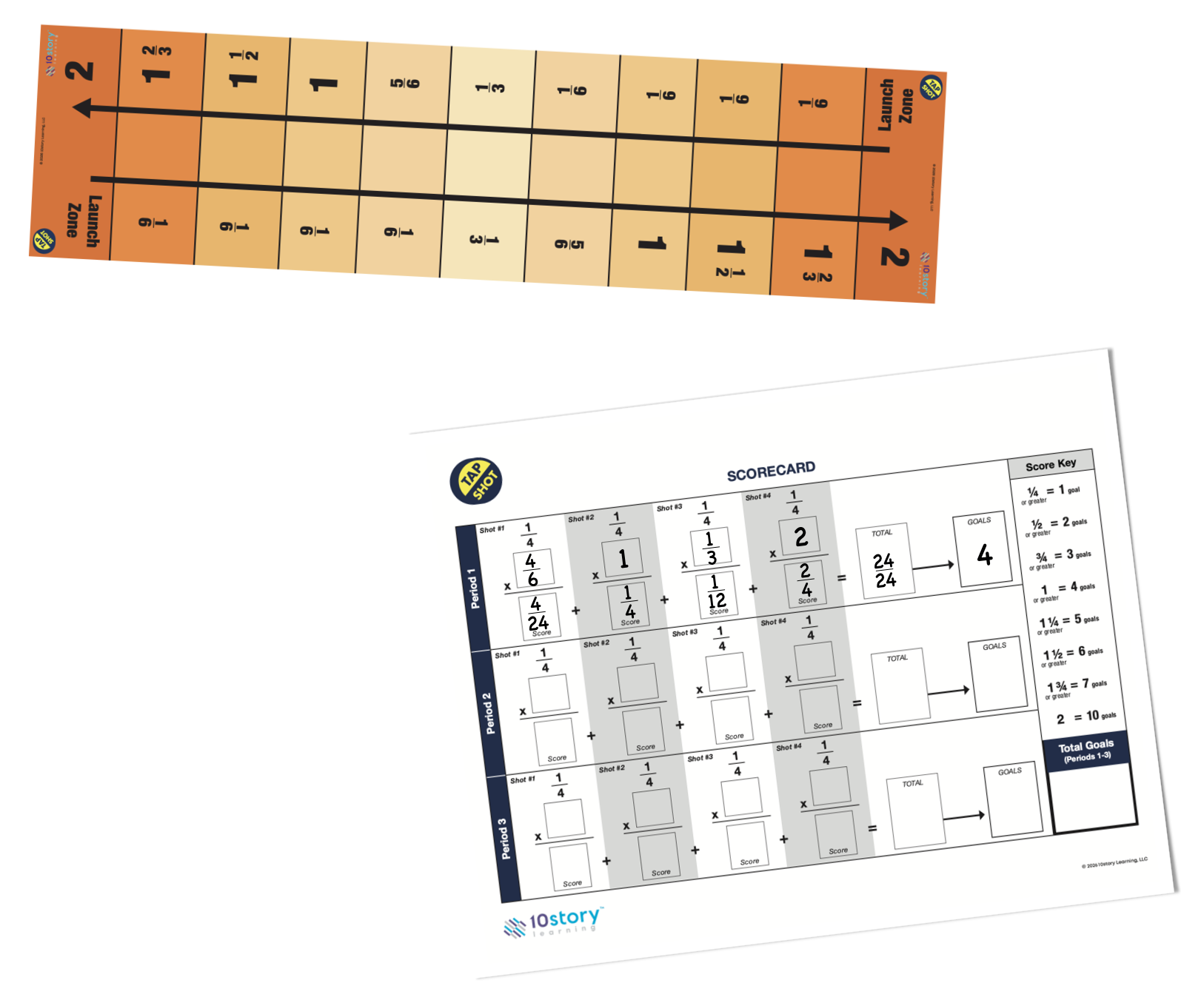
Multiplying a fraction by a fraction remains one of the more abstract operations students encounter. Tap Shot gives this operation repeated context: slide a coin into a scoring zone, then multiply that value by 1/4 to calculate points. Land on 2, multiply by 1/4, score 1/2. Land on 1 2/3, multiply by 1/4, score 5/12. The physical action grounds what can feel like arbitrary symbol manipulation.
The game uses a constant multiplier—always 1/4, representing the value of a quarter—which supports pattern recognition without sacrificing challenge. Students work with varied zone values (whole numbers like 2, fractions like 1/2, mixed numbers like 1 2/3), requiring different approaches each time. Multiplying 1 2/3 by 1/4 demands converting to 5/3 first, yielding 5/12. Multiplying 1/2 by 1/4 produces 1/8. The multiplier stays constant, but the cognitive work varies.
After each player takes four shots, they add their scores to find their period total. This creates the second mathematical layer: adding fractions with unlike denominators. A player might need to sum 1/2 + 1/8 + 1/3 + 5/12, requiring a common denominator of 24. The addition serves clear purpose—it determines who's winning—rather than existing as isolated practice.
The conversion chart at the end adds a final step: translating fraction totals into whole number goals. Players compare their totals against benchmarks (3/4 = 2 goals, 1 1/4 = 4 goals) to determine the winner. This builds facility with fraction magnitude—understanding where values fall relative to common reference points.
Strategic tension emerges from understanding fraction magnitude: Should you aim for the 2 zone (yielding 1/2 points) or settle for the safer 1 zone (yielding 1/4 points)? Players who grasp that 1/2 > 1/4 gain competitive advantage, turning abstract comparison into concrete decision-making.
The competitive structure motivates computational accuracy. An error multiplying 1 2/3 × 1/4 or finding common denominators costs points. Students check their work not because a teacher requires it, but because winning depends on it. This shifts calculation from compliance to strategy.