

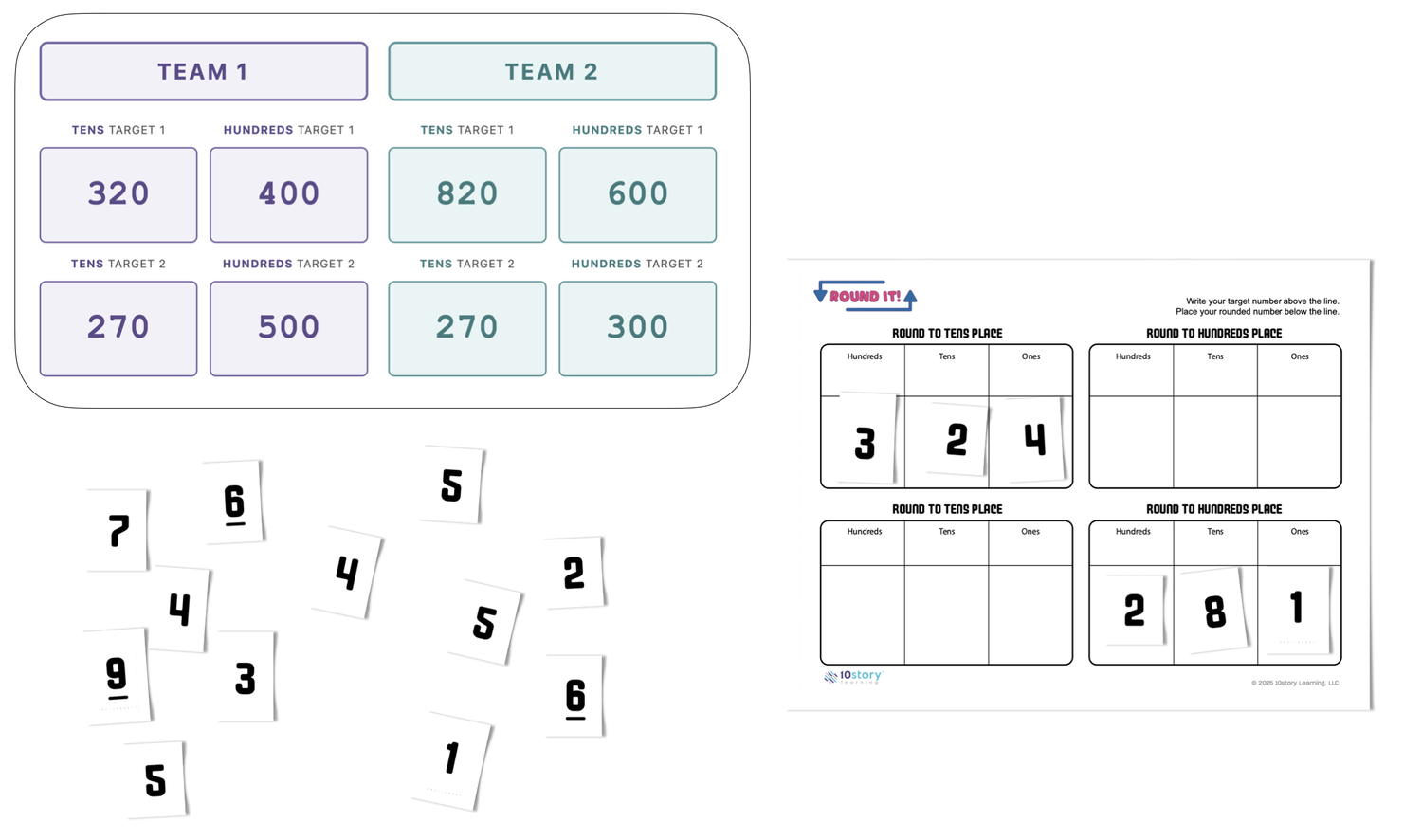
Most rounding practice asks students to take a number and round it—straightforward procedural work. Round It! reverses the task: given a target like 340, students must construct a three-digit number that rounds to it. This reversal requires understanding the range of qualifying numbers (335-344 for 340) rather than just applying a rule.
The game uses four targets per team: two require rounding to the nearest ten, two to the nearest hundred. Students must track which rounding place each target demands while managing a hand of five digit cards. On each turn, they select three cards to build a number that rounds to one of their targets.
Constructing numbers that round to specific targets reveals the relationship between place value and rounding outcomes.
Place value becomes consequential. When rounding to the nearest ten, the ones digit determines the direction (0-4 round down, 5-9 round up), but the tens digit tells you which decade you're approaching. For 347: the 4 in the tens place means you're in the 340s, and the 7 in the ones place rounds you up to 350. When rounding the same number to the nearest hundred, that 4 in the tens place now acts as the deciding digit, rounding down to 300.
Students work with digit cards 1-9, creating strategic tension. Holding 2, 3, 5, 7, 8, they might build 527 to hit a target of 530—but that 5 could be valuable later for rounding up in the hundreds place. These decisions require continuous mental evaluation of rounding possibilities across multiple targets.
Students can't pause to count on fingers or draw number lines. They develop automatic recognition of which numbers fall into which rounding ranges through repeated, time-pressured construction tasks.
Boundary cases appear naturally. Students quickly encounter situations where a number like 535 sits exactly between two multiples of ten. The standard convention (round 5 up) becomes meaningful through gameplay rather than memorization—when students realize that treating 535 as rounding to 540 gives them strategic flexibility, the convention makes practical sense.
The game also makes visible a common point of confusion: the difference between "the nearest multiple of 10" and "the nearest multiple of 100." Students see that 340 (nearest ten) and 300 (nearest hundred) require different numbers constructed from the same digit cards. Working with both types simultaneously builds flexibility rather than letting students conflate the two procedures.