
Mega Bingo - Fraction Operations Game | 10story Learning

Add, subtract, multiply & divide fractions

Use fractions to get a bingo!
Mega Bingo Game Setup
Grades
4-6
Game Length
30 minutes
Game Type
Strategic, Collaborative
  • Add and subtract fractions with unlike denominators. (5.NF.A.1)
  • Multiply a fraction or whole number by a fraction. (5.NF.B.4)
  • Divide unit fractions by whole numbers and whole numbers by unit fractions. (5.NF.B.7)
1

Inside the Math

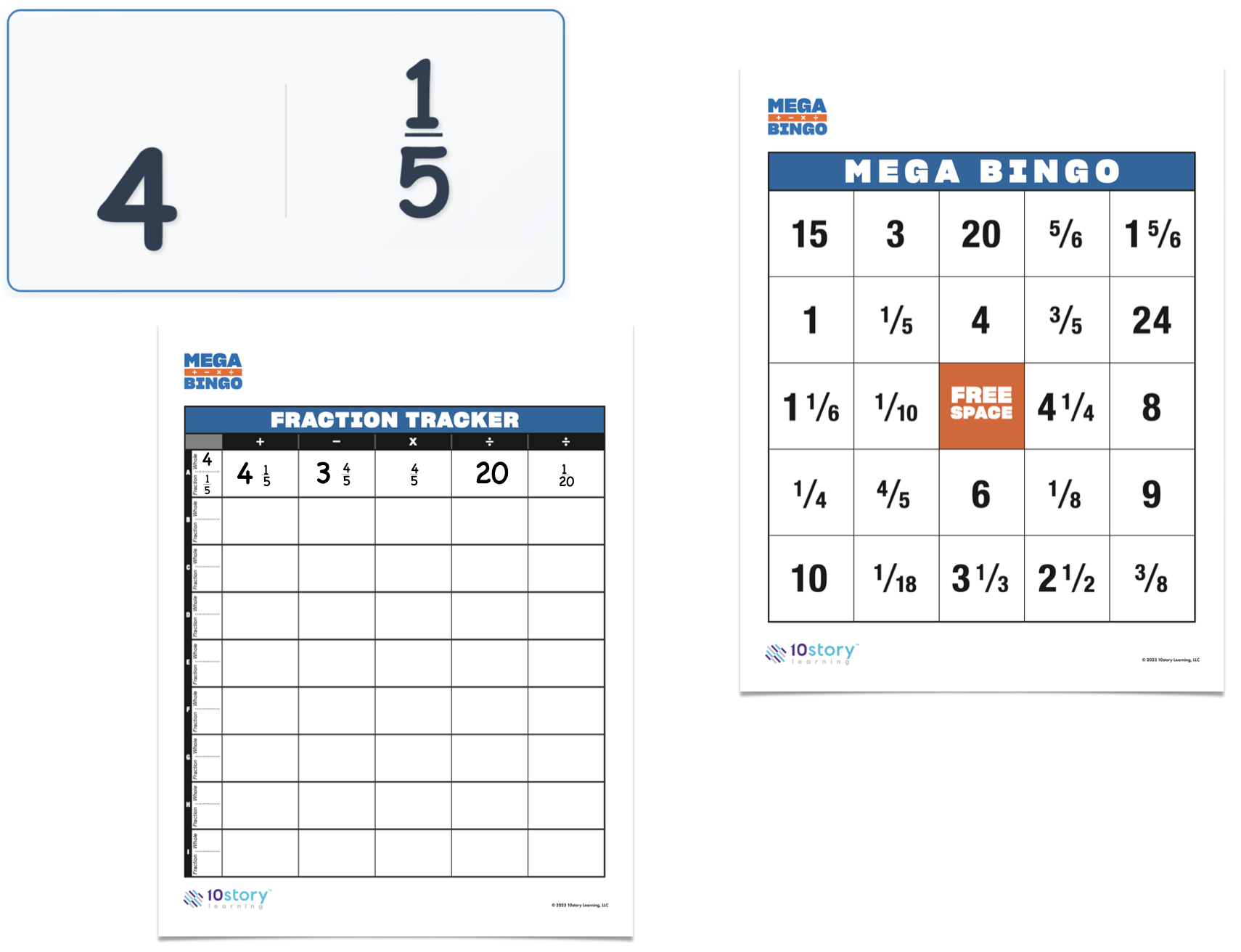
Most fraction curricula teach operations in isolation: a unit on addition, another on multiplication, separate lessons for each type of division. Mega Bingo does the opposite—students compute all five operations on the same pair of numbers, round after round. When the generator produces 4 and ½, teams calculate 4 + ½ = 4½, 4 - ½ = 3½, 4 × ½ = 2, 4 ÷ ½ = 8, and ½ ÷ 4 = ⅛. Same inputs, wildly different outputs depending on the operation.

This systematic approach does two things at once. First, it builds procedural fluency through distributed practice—over a game, students might perform 75-100 calculations across all five operations. Second, it makes operational relationships visible. Students see that multiplication and division produce more dramatic changes than addition and subtraction, that dividing by a fraction yields larger results while dividing a fraction yields smaller ones, that the two division operations create reciprocal relationships.

The same two numbers, five different operations, five different meanings.

Each operation has distinct conceptual grounding. Addition combines (4 and ½ together), subtraction removes (4 minus ½), multiplication scales (4 groups of ½), division by a fraction partitions (how many halves in 4?), and division of a fraction by a whole splits (½ divided into 4 parts). These meanings map onto different computational procedures: common denominators for addition and subtraction, multiply across for multiplication, invert-and-multiply for fraction division, multiply denominator for division by a whole.

The strategic layer matters pedagogically. Students choose which of their five computed results to place on the board, considering which spaces advance their bingo pattern. This decision-making keeps engagement high—you're not just computing for its own sake, you're computing to win. And when a team calls bingo, they must verify their calculations to the room, creating natural opportunities for mathematical discourse and error correction.

Students record both starting numbers, then systematically compute and document all five results in columns. This written record serves three purposes—it organizes work during play, provides evidence for verification, and creates an artifact teachers can review to see where students struggle.

Difficulty differentiates naturally through random generation. Some rounds produce easy pairs (3 and ¼), others produce more complex calculations (15 and ⅝). The game accommodates a range of fluency levels without feeling like obvious differentiation, since every team works with the same numbers each round but at their own computational pace.

The collaborative structure lets students distribute cognitive load. Teams can split operations—one student handles addition and subtraction, another tackles the divisions—then check each other's work. This division of labor keeps wait time low while maintaining individual accountability, since every student must understand enough to verify their teammates' calculations.

2

Building Foundation for Mathematical Thinking

Computational fluency is necessary but insufficient. Mega Bingo develops operational sense—intuition about how operations behave. After computing 6 ÷ ½ = 12 multiple times across different games, students internalize that dividing by a fraction less than 1 makes results bigger. This understanding emerges through pattern recognition rather than rule memorization, making it more robust and transferable.

The game naturally encourages estimation and reasonableness checking. Before computing 8 × ⅜, students might think: "⅜ is close to ½, half of 8 is 4, so I'm expecting around 3." After calculating (getting 3), the estimate confirms accuracy. This habit of prediction and verification catches errors and builds number sense. Students who estimate 4 ÷ ½ will get 2 immediately know something went wrong.

Teams must decide which computed result to place, considering board position, probability of getting certain numbers again, and what opponents might be building toward. The math serves a larger game-theoretic purpose, keeping engagement high across extensive computational practice.

Flexibility with fraction representations develops naturally. Students move between improper fractions and mixed numbers depending on context—3 + ⅔ might be easier to think about as 3⅔, but computing requires converting to 11/3. The game rewards representational fluency since efficient computation strategy can mean the difference between placing a result before opponents do.

Pattern recognition beats memorization for building durable understanding.

Error analysis happens organically through verification. When a winning team's calculations are checked, computational mistakes become teaching moments for the whole class. Seeing someone claim 4 ÷ ½ = 2 (confusing it with 4 × ½) helps everyone distinguish the two operations more clearly. These errors aren't failures—they're data about what students need to practice.

The Fraction Tracker makes relationships visible. Looking at a completed row, students can see how the five operations compare: addition and subtraction stay close to the original numbers, multiplication often produces smaller results when fractions are involved, the two divisions move in opposite directions. These observations build operational sense that extends beyond specific calculations.

Perhaps most importantly, extensive practice happens without feeling like drill. Students might complete 300-400 calculations across three games, but because those calculations serve strategic purposes in an engaging competition, they don't feel like work. The game structure creates what practice often lacks: immediate purpose for each computation.

3

In the Classroom

Students need basic procedural knowledge before playing—how to find common denominators for addition/subtraction, how to multiply fractions, how division by fractions works. The game is practice and application, not initial instruction. If students are still learning these procedures, start with fewer operations (just addition/subtraction or just multiplication/division) before building up to all five.

Complexity adjusts easily through the number generator. For students building fluency, use unit fractions (½, ⅓, ¼) with small whole numbers (1-10). For more advanced students, include fractions with larger numerators (⅝, 7/12) and whole numbers up to 32. The game structure stays the same; only the computational difficulty varies.

Each team needs one bingo card and tokens for marking spaces. Each student needs their own Fraction Tracker and pencil for recording work. The digital generator runs on any internet-connected device. Groups of 2-3 students per team work well, with up to 14 teams playing simultaneously.

Team composition matters. Heterogeneous grouping enables peer teaching—stronger students explain procedures to teammates. Homogeneous grouping ensures everyone works at an appropriate challenge level. Neither is universally better; choose based on your current instructional goals and class dynamics.

First games focus on accuracy; experience brings strategy.

Before the first game, model the computational sequence with a sample pair. Show how 6 and ⅓ become 6⅓ (addition), 5⅔ (subtraction), 2 (multiplication), 18 (division by fraction), and 1/18 (division of fraction). Demonstrate recording these five results in the Tracker columns. Work through 2-3 examples with the class so everyone understands the structure.

Early rounds take longer—teams might need 3-5 minutes to compute all five operations and decide which result to place. With practice, this drops to 1-2 minutes. The acceleration itself is evidence of developing fluency. Don't rush; speed develops naturally through repetition.

When a team calls bingo, they share their Tracker showing all calculations used. Other teams check the work. Errors mean gameplay continues—and everyone learns from analyzing the mistake. Frame this as collaborative problem-solving, not catching cheaters.

Common errors reveal conceptual gaps. If students confuse 4 ÷ ½ with 4 × ½, pause for discussion about how division by a fraction differs from multiplication. If teams struggle with common denominators, that's data about where re-teaching is needed. The game makes student thinking visible.

Extensions for quick finishers: estimate before computing to practice number sense, find patterns across multiple rounds (which operations produce whole numbers? when do results get bigger vs. smaller?), or figure out which board spaces are most strategically valuable given the number distribution.

Support for struggling students: provide procedure reference sheets, allow fraction manipulatives for conceptual grounding, pair with a peer checker, or temporarily reduce to three operations (addition, subtraction, multiplication) before adding the two division types.

Post-game reflection cements learning. Ask: Which operation was hardest? What shortcuts did you discover? What strategies helped you choose which results to place? These discussions help students articulate developing understanding and identify what they still need to practice. The activity drives the mathematics.