
Fraction Frosting - Unit Fractions Game | 10story Learning

Fractions as parts of a whole

Place halves and thirds to make the most doughnuts!
Fraction Frosting Game Setup
Grades
3-5
Game Length
10 minutes
Game Type
Hands-On, Competitive
  • Understand a fraction 1/b as the quantity formed by 1 part when a whole is partitioned into b equal parts; understand a fraction a/b as the quantity formed by a parts of size 1/b. (3.NF.A.1)
1

Inside the Math

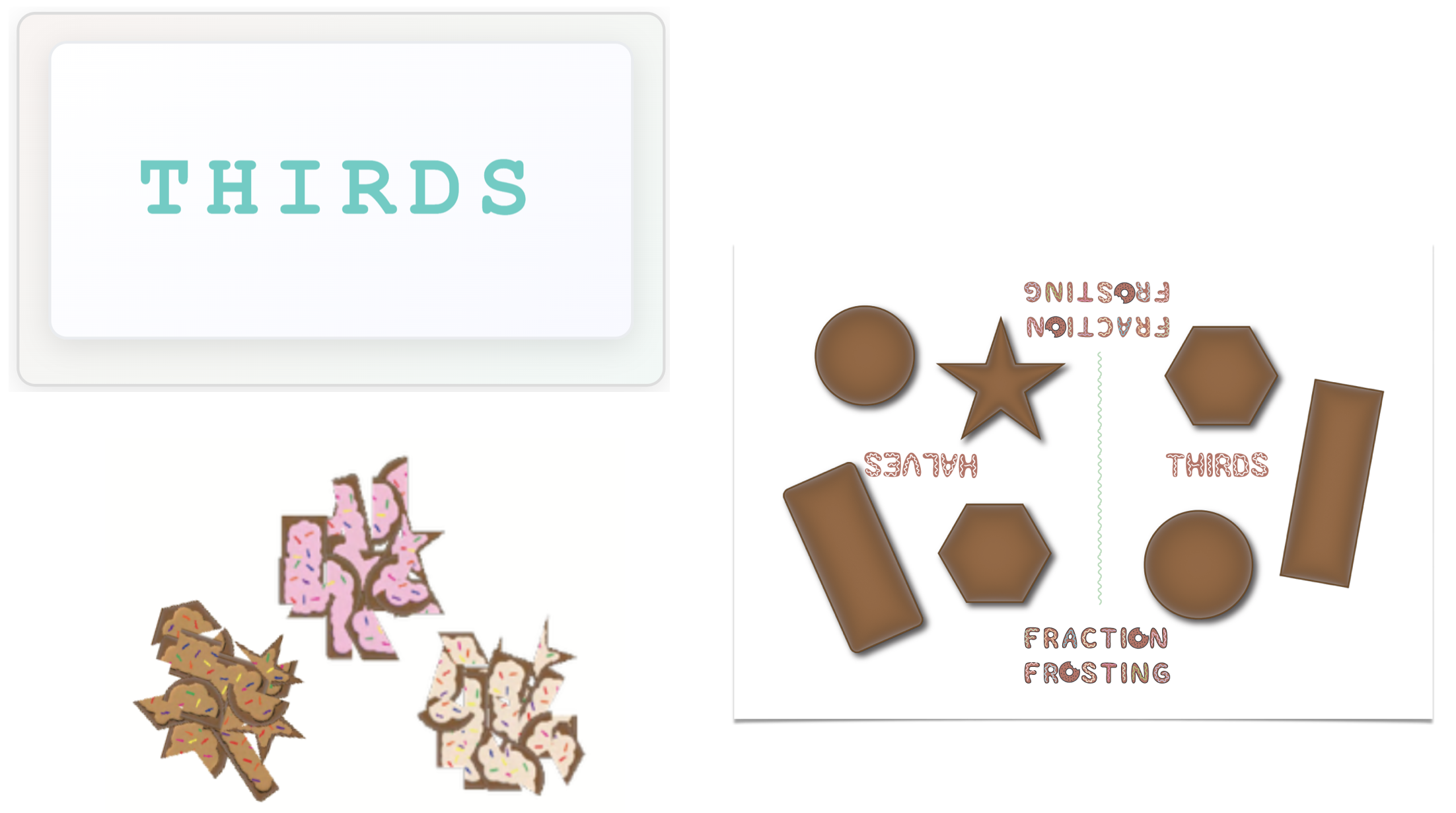
Fraction Frosting isolates a specific pedagogical move: building wholes from unit fractions through competitive placement. Students receive random halves or thirds from a digital generator and place them on shared doughnut spaces. Complete a doughnut (two halves or three thirds), collect it. Most doughnuts wins.

The game design creates repeated practice with the relationship 3.NF.A.1 emphasizes: understanding 1/b as one part when a whole is partitioned into b equal parts, and a/b as a parts of size 1/b. Each placement requires students to evaluate partial doughnuts—seeing a doughnut with one-third as needing two more thirds (2/3 remaining), or a doughnut with one half as halfway complete.

What makes this pedagogically interesting is the constraint: you don't choose your fraction. The generator gives you either a half or a third, forcing flexible application rather than predetermined strategy. This constraint mirrors how fraction problems actually work—you solve the problem you have, not the one you wish you had. Students develop adaptability, finding productive placements for whatever piece they receive.

The shared board creates tension between immediate completion and longer-term strategy. Place your third on a doughnut that already has two-thirds? You complete it now. Or start a new doughnut, hoping to finish it later? These decisions require tracking multiple partial wholes simultaneously and assessing completion probability given random piece generation. The competition makes this tracking purposeful rather than abstract exercise.

If a half piece doesn't fit in the remaining space on a doughnut, the student has made an error in tracking. This tactile feedback makes fraction misconceptions visible and correctable in real-time, without teacher intervention.

Different doughnut shapes (circles, stars, hexagons, rectangles) prevent students from overfitting their fraction understanding to circular models. The whole changes, but the fractional relationship remains constant: two halves always make one, three thirds always make one, regardless of the shape being partitioned. This shape variety supports transfer of fraction concepts beyond pizza-and-pie contexts.

The game creates natural opportunities for additive reasoning with fractions. A doughnut with one-third that receives another one-third now has two-thirds. While students aren't writing 1/3 + 1/3 = 2/3, they're enacting this operation physically. This embodied experience with fraction addition precedes and supports formal symbolic work.

Collecting completed doughnuts provides concrete evidence of successful composition: these separate pieces, combined correctly, made this whole. The collection mechanic transforms abstract fraction work into tangible achievement, creating a feedback loop between physical action (placing pieces) and mathematical outcome (completing wholes).

2

Building Foundation for Mathematical Thinking

The game operates on an embodied cognition principle: fraction concepts develop through physical manipulation before symbolic representation. Students handle fractional pieces, fit them into spaces, and collect completed wholes hundreds of times across multiple games. This repeated sensorimotor experience builds intuitive understanding that transfers to symbolic work later.

Competition serves a pedagogical function here beyond mere engagement. The race to collect doughnuts requires students to continuously scan the board, evaluate completion states, and make strategic decisions—cognitive activities that develop fraction magnitude sense. A doughnut with two-thirds is "almost done" in a way that a doughnut with one-third isn't, and competition makes these distinctions urgent and meaningful.

The random generator introduces productive constraint. In typical fraction exercises, students work through predetermined problems. Here, the mathematical situation changes each turn based on what piece you receive. This variability develops flexible fraction thinking—students can't rely on memorized procedures but must evaluate each placement in context. The constraint also creates authentic problem-solving where optimal solutions depend on both mathematical understanding and strategic positioning.

Students must remember that the star has two-thirds, the circle has one-half, and the rectangle is empty—while simultaneously planning where to place their current piece. This cognitive load mirrors the mental tracking required in fraction computation.

The game naturally differentiates between students at different levels. Some students focus entirely on completing doughnuts they've already started, showing basic part-whole understanding. Others develop sophisticated strategies: starting multiple doughnuts to create more completion opportunities, or deliberately avoiding doughnuts that opponents are close to finishing. These strategic variations reveal different levels of fraction reasoning without requiring separate activities.

Peer interaction during gameplay creates opportunities for distributed cognition. When students debate whether a doughnut is complete, they externalize their fraction reasoning: "It needs one more half" or "No, that's already a whole—it has three thirds." These verbalizations make implicit understanding explicit and allow students to test their reasoning against others' thinking.

The physical pieces provide what learning scientists call "productive failure" opportunities. If a student misunderstands the current state of a doughnut and places the wrong piece, the mismatch becomes immediately apparent—either the piece doesn't fit, or the doughnut isn't complete when the student thought it would be. These micro-failures, in a low-stakes game context, are learning opportunities rather than errors to avoid.

The 10-minute game length enables deliberate practice structure: play a game, discuss what happened, play again with refined strategies. This tight feedback loop supports strategy development and mathematical reflection. Students can test hypotheses ("I'll try starting three doughnuts instead of focusing on one") and observe results within a single class period.

3

In the Classroom

Fraction Frosting works best as early fraction practice, ideally after students have been introduced to halves and thirds but before formal fraction notation or operations. The game builds intuitive understanding that supports later symbolic work—students develop fraction sense through physical manipulation, then connect that sense to abstract representations.

Setup is minimal: print the game board and fraction pieces (available in materials), place board in the center, give each player one set of pieces, open the digital fraction generator. For 2-3 players, two players creates cleaner strategic choices since doughnuts fill more predictably. With three players, the competition intensifies but also introduces more variability—harder to plan since more placements happen between your turns.

First, can students identify where pieces can legally be placed? This shows they recognize which partial doughnuts have space for halves versus thirds. Second, do they notice completion opportunities before placing? Students who scan the board first demonstrate stronger fraction magnitude sense than those who randomly place pieces.

The random generator is pedagogically intentional, not just mechanical convenience. Students learn that mathematical situations aren't always customizable—sometimes you work with the tools available. This constraint-based reasoning appears throughout mathematics, and the game introduces it in a concrete, low-stakes context.

Early games often show students focusing myopically on single doughnuts: "I'm working on the star." More sophisticated play emerges after several rounds as students realize spreading pieces across multiple doughnuts creates more completion opportunities. This strategic evolution parallels mathematical development—moving from local thinking to global optimization.

Student disagreements about whether doughnuts are complete reveal fraction misconceptions worth addressing. If a student thinks two-thirds is complete, they're operating with incorrect part-whole understanding. These moments are teaching opportunities: "Count the pieces—how many thirds does this doughnut need? How many does it have?" Let the physical pieces resolve the disagreement rather than teacher declaration.

The game naturally supports differentiation without separate activities. Struggling students can count pieces explicitly ("one-third, two-thirds...") and verify completion before claiming doughnuts. Advanced students can be challenged to predict completion probability: "You have a doughnut with two-thirds. What are the chances you'll complete it on your next turn?" This connects fraction work to early probability reasoning.

Ten minutes per game enables multiple rounds in one class period. Play, discuss strategy, play again. This iteration cycle lets students test hypotheses and refine approaches. Post-game discussion might ask: Which doughnuts were easiest to complete? (Reveals students noticing denominator differences.) Did the random generator favor anyone? (Early probability thinking.) What strategy would you try next game? (Metacognitive reflection.)

Common student strategies that emerge include: completion focus (always finish doughnuts you start), opportunity maximization (spread pieces to create multiple completion chances), and defensive play (avoid helping opponents' near-complete doughnuts). Each strategy demonstrates different aspects of fraction reasoning. Teachers can highlight these approaches during discussion without designating any as "correct"—the game accommodates multiple valid strategies.

For classrooms using this in math workshop, Fraction Frosting fits naturally into a hands-on station. Students can play independently once they understand rules, making it suitable for center-based learning. The short play time means students can complete games within typical station rotations, and the competitive element maintains engagement without teacher facilitation.

After several games, connect physical manipulation to symbolic notation: "Draw the star doughnut when it had two-thirds. How would we write that as a fraction?" This bridges embodied understanding to abstract representation, using the concrete game experience as referent for symbolic work. Students who've physically built wholes from fractions are better positioned to understand fraction notation than those who only encounter symbols. The activity drives the mathematics.