

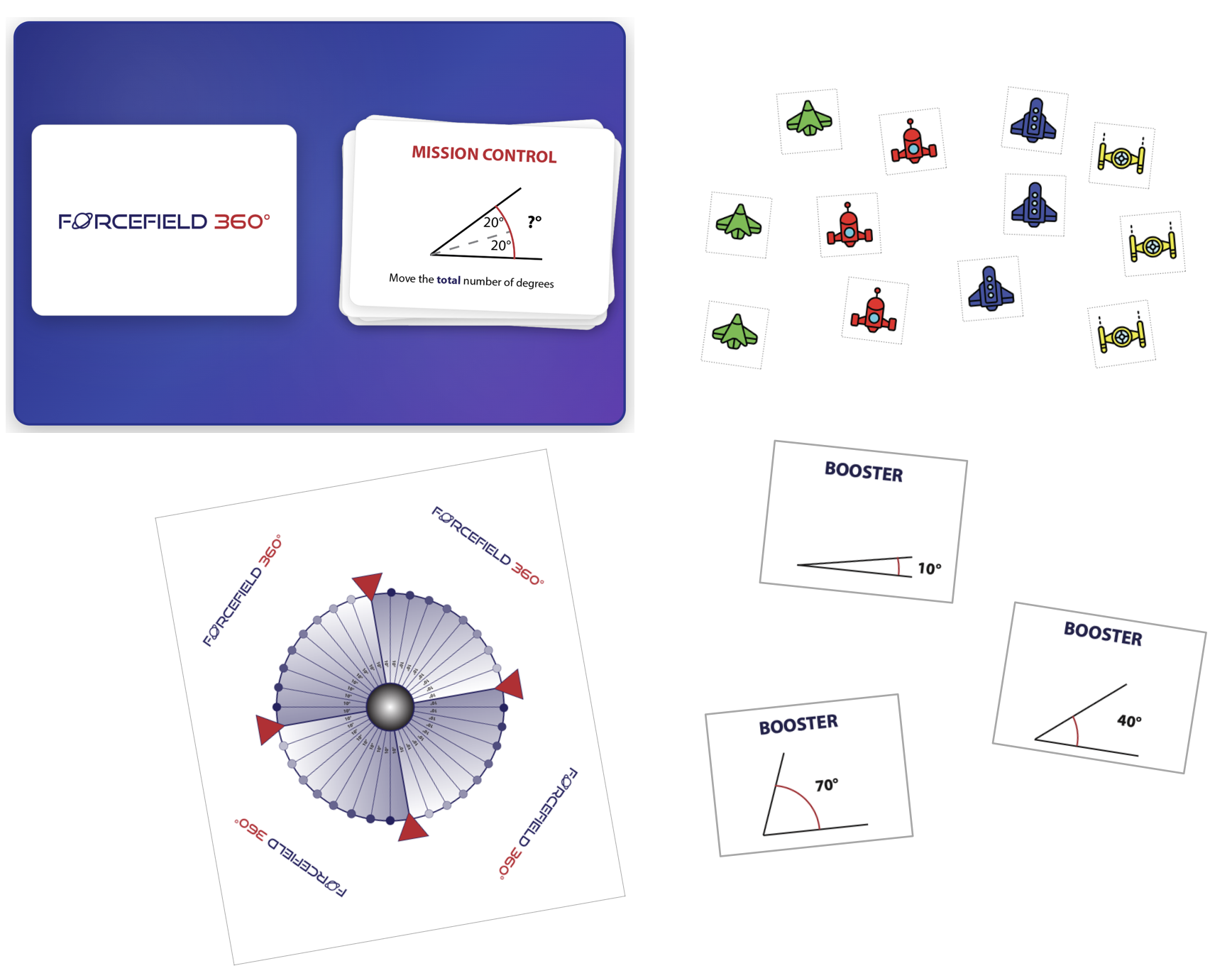
Most elementary students learn angles as static shapes—corners or wedges on a page. Forcefield 360 shifts this understanding by making angles describe rotation. The game board is a circle divided into 36 wedges of 10° each, and students move rocketships around this orbit by adding angle measures from cards they draw.
Each turn presents a straightforward mathematical task: draw an angle card (ranging from 10° to 80°), optionally add a booster card, calculate the sum, and move that many degrees. The goal is to land exactly on one of the forcefield gates scattered around the orbit. Miss the gate, and you circle past it—sometimes requiring several more turns to line up another approach.
This structure gives students repeated practice with the additive property of angle measurement. When a student plays 40° plus a 20° booster, the total rotation is 60°. The calculation has immediate spatial consequences: the rocketship moves to a new position. Over many turns, students internalize that angle measures combine the same way other quantities do.
The competitive element creates a reason to calculate accurately. If you're 30° from a gate and draw 50°, you need to decide: play it and overshoot by 20°, or add a booster to overshoot by more but potentially set up for a different gate. This kind of planning requires mental angle addition and subtraction.
The circular structure makes the 360° composition of a full rotation visible rather than abstract. Students can count wedges, trace paths, and verify that 36 movements of 10° return a rocketship to its starting position. The board becomes a concrete reference for angle magnitude: 90° is a quarter turn, 180° is halfway around, 270° is three-quarters.
Mission Control cards add complexity by presenting multi-step problems. A card might show two angles and ask students to move the sum, or present a word problem requiring interpretation before calculation. These cards mix procedural fluency with problem-solving in the same game structure.
The 360° circle structure provides concrete spatial references for angle magnitude.
The three booster cards per player introduce resource management. With six possible angle values in the deck, students learn which boosters provide the most strategic flexibility. A 10° booster can fine-tune almost any draw; an 80° booster enables large jumps but can easily cause overshoots. Deciding when to use limited resources adds a layer of planning to the angle arithmetic.
The game also surfaces common misconceptions quickly. Students who miscalculate 70° + 20° as 72° (a place value error) will move incorrectly and miss their gate. The spatial feedback is immediate—the rocketship ends up in the wrong position—making computational errors visible in a way worksheet problems don't.
For students accustomed to thinking of angles as shapes, the game offers a different entry point: angles as measures of rotation around a center point. This dynamic conception supports later work with angle relationships, transformations, and trigonometry.