

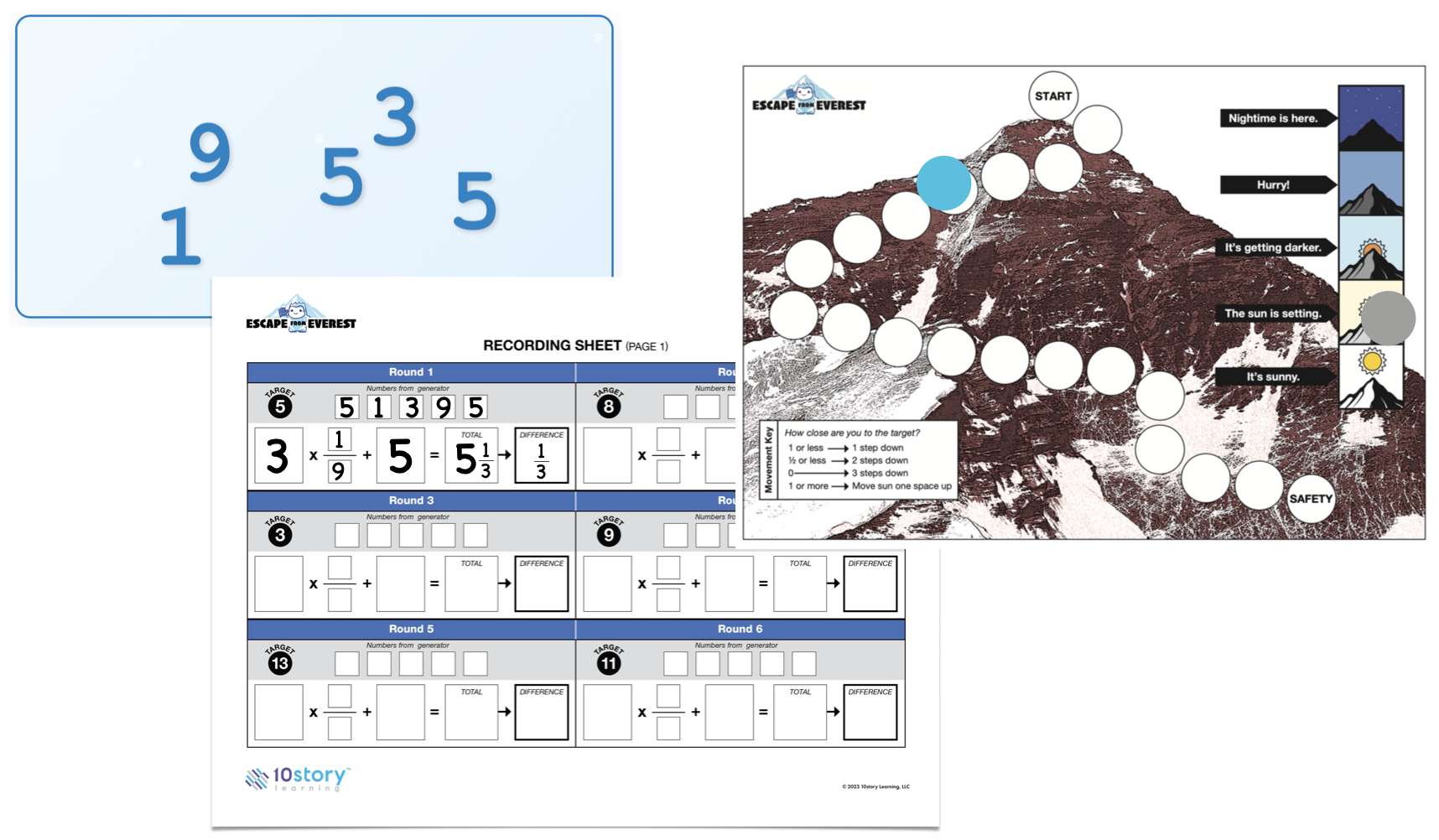
Each round, students receive five random numbers and must select four to construct an equation: whole number × fraction + whole number. The constraint that the fraction's numerator must be less than its denominator means students work exclusively with proper fractions. Given 9, 5, 2, 6, and 4 with a target of 5, students might try 9 × 2/6 + 2 or 6 × 4/5 + 2, each producing different results.
This structure addresses a common difficulty with fraction multiplication: students learn the algorithm (multiply by numerator, divide by denominator) without developing intuition about what happens when you multiply by a fraction less than one. The rule that proper fractions make numbers smaller becomes concrete through repeated experience. Multiply 8 by 3/4 and you get 6. The product is always between zero and the original whole number.
The target-matching mechanism develops estimation. Students don't need exact answers—just close ones. If the target is 5, then 9 × 2/6 + 2 = 5 is perfect, but 9 × 4/6 + 1 ≈ 7 still works. This tolerance for approximation encourages students to estimate before calculating: will 9 × 4/6 be bigger or smaller than 5? Is it even worth checking precisely?
The addition step adds strategic complexity. Students must decide which number to multiply, which two to use in the fraction, and which to add. This creates a genuine puzzle: with 5, 6, 3, 4, and 2 targeting 8, should you try 6 × 3/4 + 2 or 5 × 4/6 + 3? The addition component allows students to adjust if their multiplication overshoots or undershoots.
Productive disagreement emerges naturally: One player suggests 8 × 3/5 + 1 while another proposes 5 × 4/6 + 2. To decide, the team must articulate why each option might work, estimate the results, and evaluate which gets closer. This externalization of mathematical thinking is where learning happens.
The game implicitly introduces absolute difference through movement rules. A result of 6 when the target is 5 moves the same distance as a result of 4—both are off by 1. Students experience the concept that "distance from target" doesn't care about direction. This intuitive understanding of absolute value emerges naturally from gameplay.
Pattern recognition develops across rounds. Fractions like 5/6 keep most of the whole number; fractions like 1/6 take only a small piece. Students begin to see these as scaling factors: 5/6 scales down slightly, 1/2 cuts in half, 2/3 takes most but not all. This intuition about fraction magnitude—harder to develop through worksheets—emerges from strategic necessity.
The time pressure from the advancing sun creates urgency without anxiety. Teams can afford a few bad rounds as long as they make steady progress. This low-stakes environment supports risk-taking: students try equations they're not sure about, check if they work, and adjust strategy for the next round. The game provides what drill-and-practice rarely does—a reason to care whether the answer is right.