Build the next big game.
Master fraction operations.
Students play three oversized fraction games — then design a complex original game of their own.
The Next Big Game is a 10-session, 15–20 hour hands-on Math Lab. Student teams play three oversized fraction games — Rollerslide, Collision, and Apex — then design a complex original game of their own. They roll marbles down 200 cm ramps, flick curling pucks across 33″×22″ double-sided boards, toss bean bags along 55″ tracks, and ultimately build their own physical game using craft materials and scoring rules that require fraction operations. The lab culminates in a Game Expo where teams present and play each other's creations.
Students start with physical fraction work — measuring and marking a meter stick, adding and subtracting fractions with like denominators in structured mini games. Then the games get harder: Rollerslide introduces unlike denominators, Collision introduces fraction multiplication, and Apex introduces fraction division. By the time students design their own game, they've used fraction operations as scoring mechanics, measurement tools, and design constraints — moving from physical gameplay to original game design where the math is embedded in every decision.
How the curriculum works
The first five sessions put students inside structured fraction games, each targeting a different operation. The second five sessions flip students from players to designers — they plan, build, test, and present a complex original game.
- Session 1: Make a meter stick — measure, mark, and label fractional units on a blank strip, building a reference tool used throughout the lab.
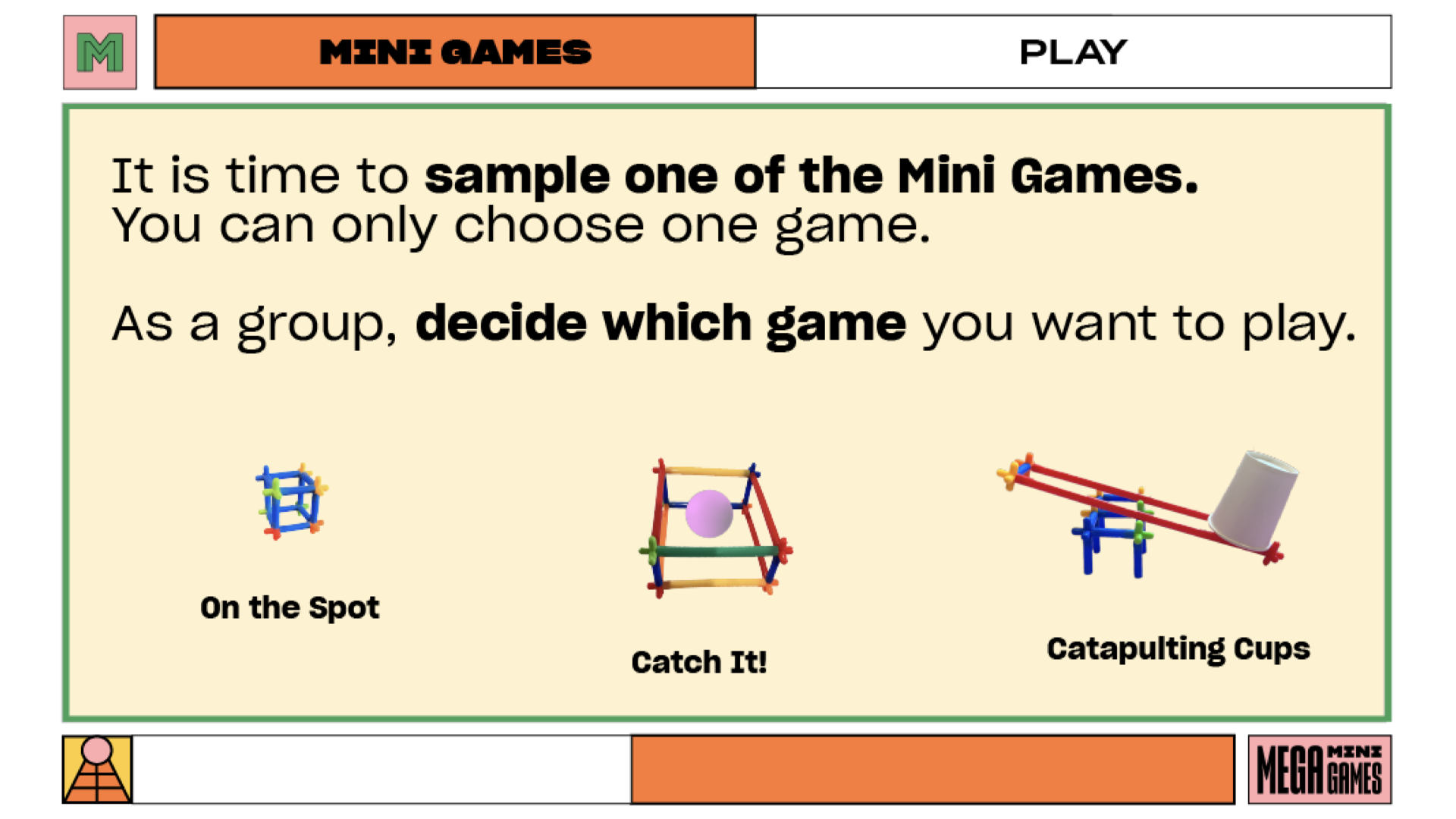
- Session 2: Play Mini Games — add and subtract fractions with like denominators using game cards, dice, and meter sticks.
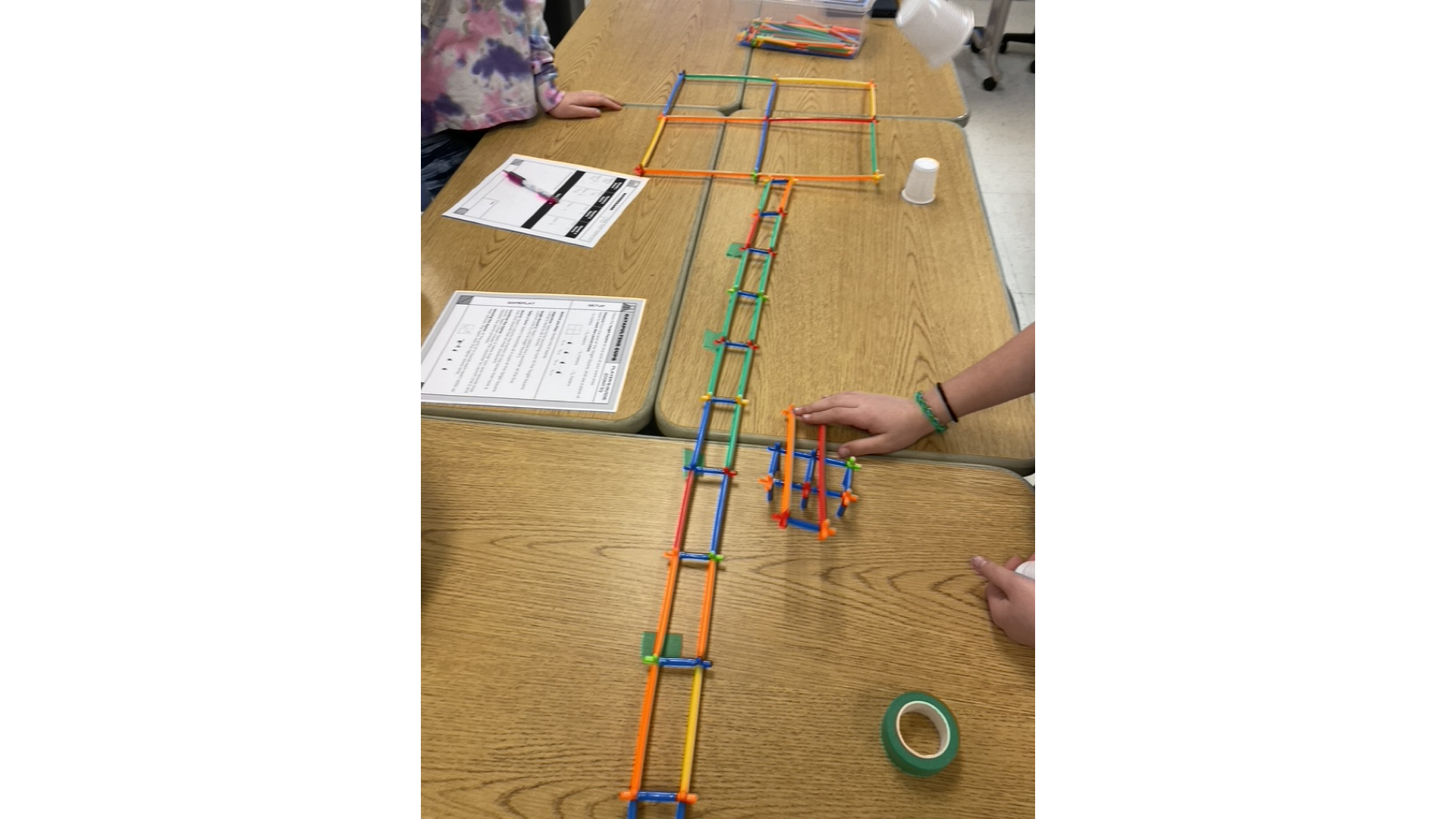
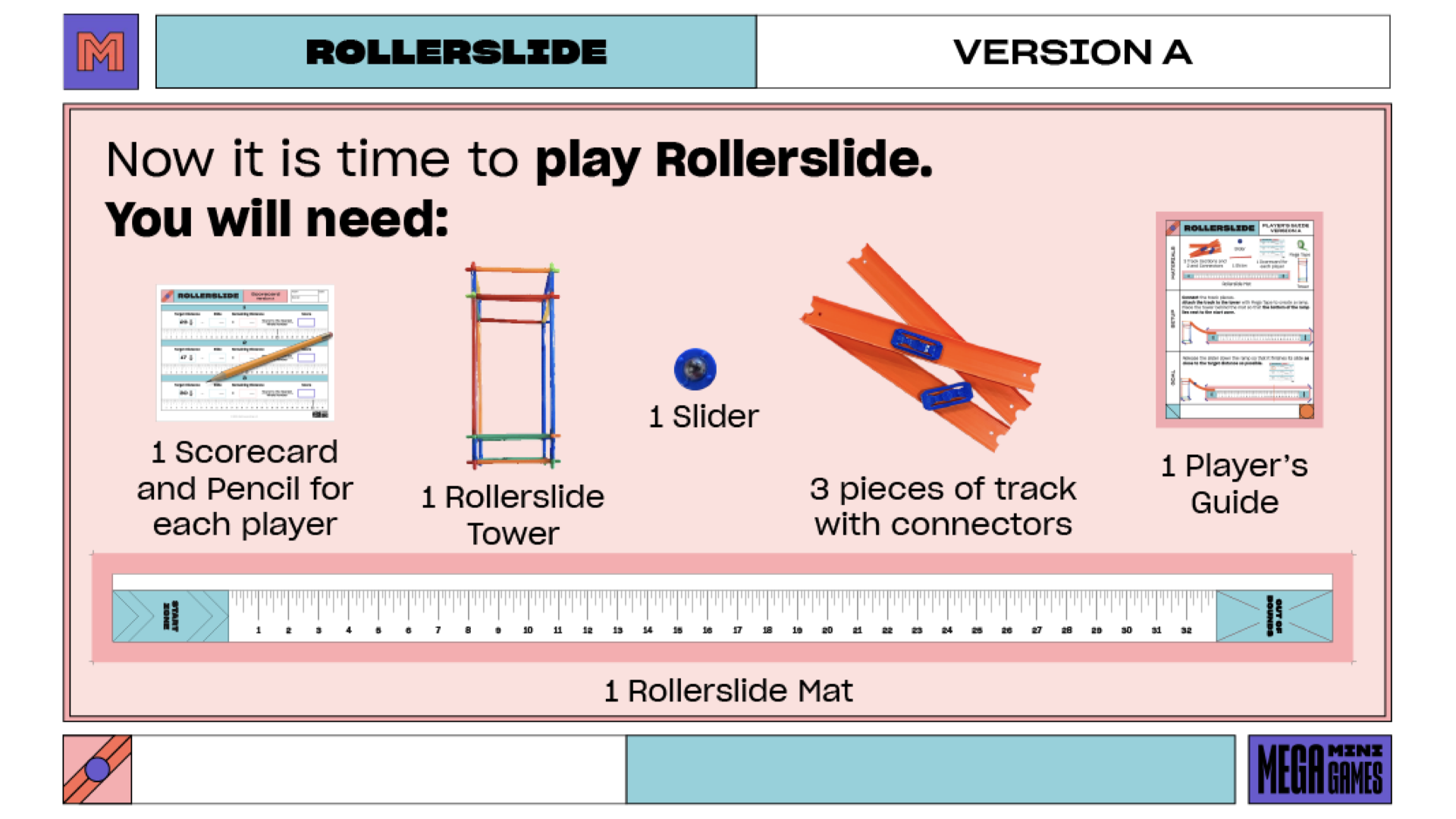
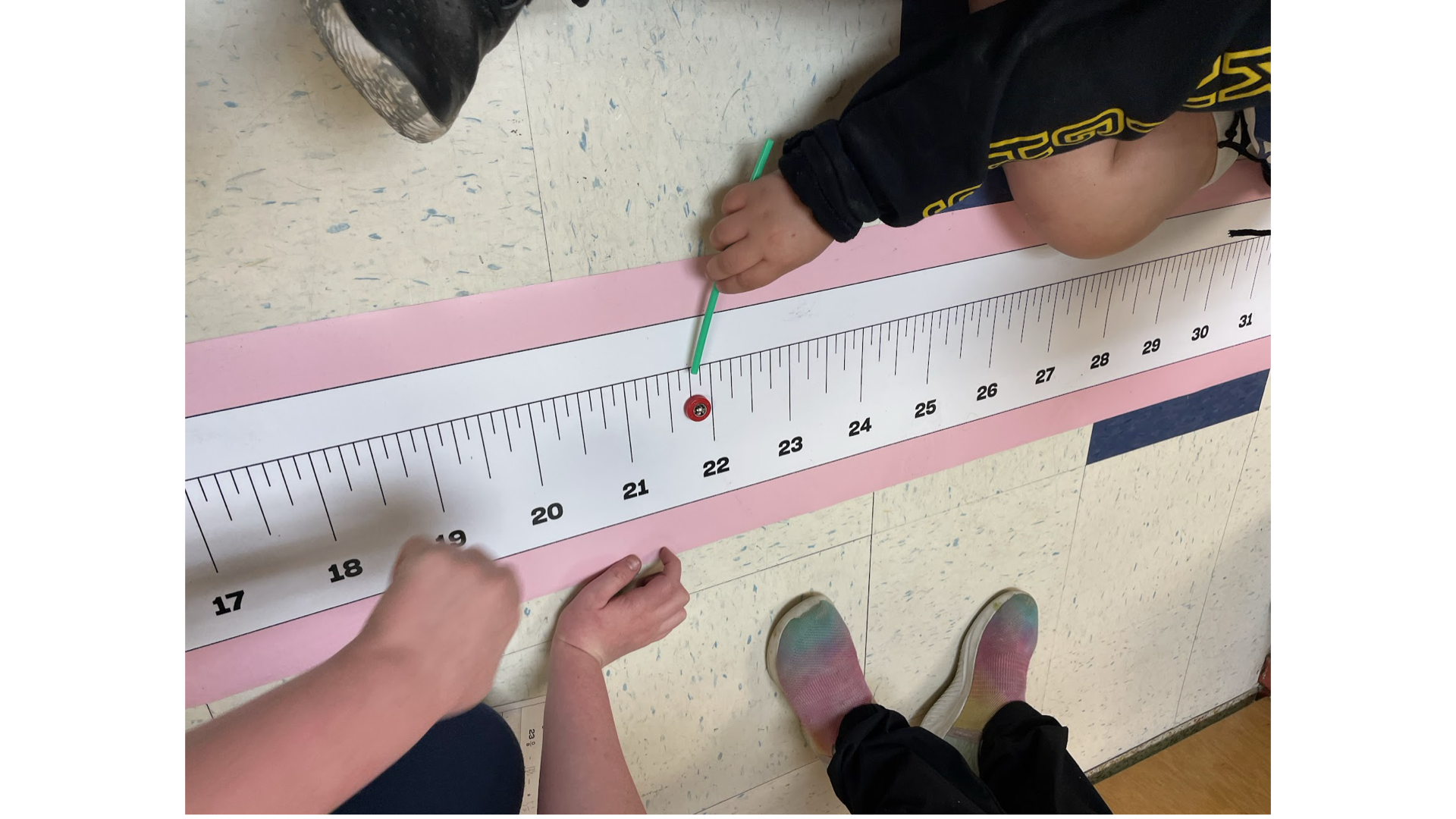
- Session 3: Play Rollerslide — roll marbles down 200 cm ramps and score by adding and subtracting fractions with unlike denominators.
- Session 4: Play Collision — flick curling pucks across a double-sided game board (33″×22″) and multiply fractions to calculate scoring zones.
- Session 5: Play Apex — toss bean bags along a 55″ track and divide fractions to determine final scores.
- Sessions 6–7: Receive design training and draft a game plan with rules that require fraction operations.
- Sessions 8–9: Build the game using craft materials and physical components, then create a scorecard that requires fraction operations to play.
- Session 10: Game Expo — every team presents, plays, and evaluates each other's games.
10 sessions at a glance
Three sample sessions
Who it's for
- 5th grade teachers looking for hands-on supplemental curriculum in fraction operations.
- 4th and 6+ grade teachers who need fraction enrichment or review.
- Afterschool and summer program directors who want structured, ready-to-run STEM programming with all materials included.
- Curriculum coordinators looking for standards-aligned fraction supplements that work alongside any core curriculum — no adoption process required.
What's in the kit
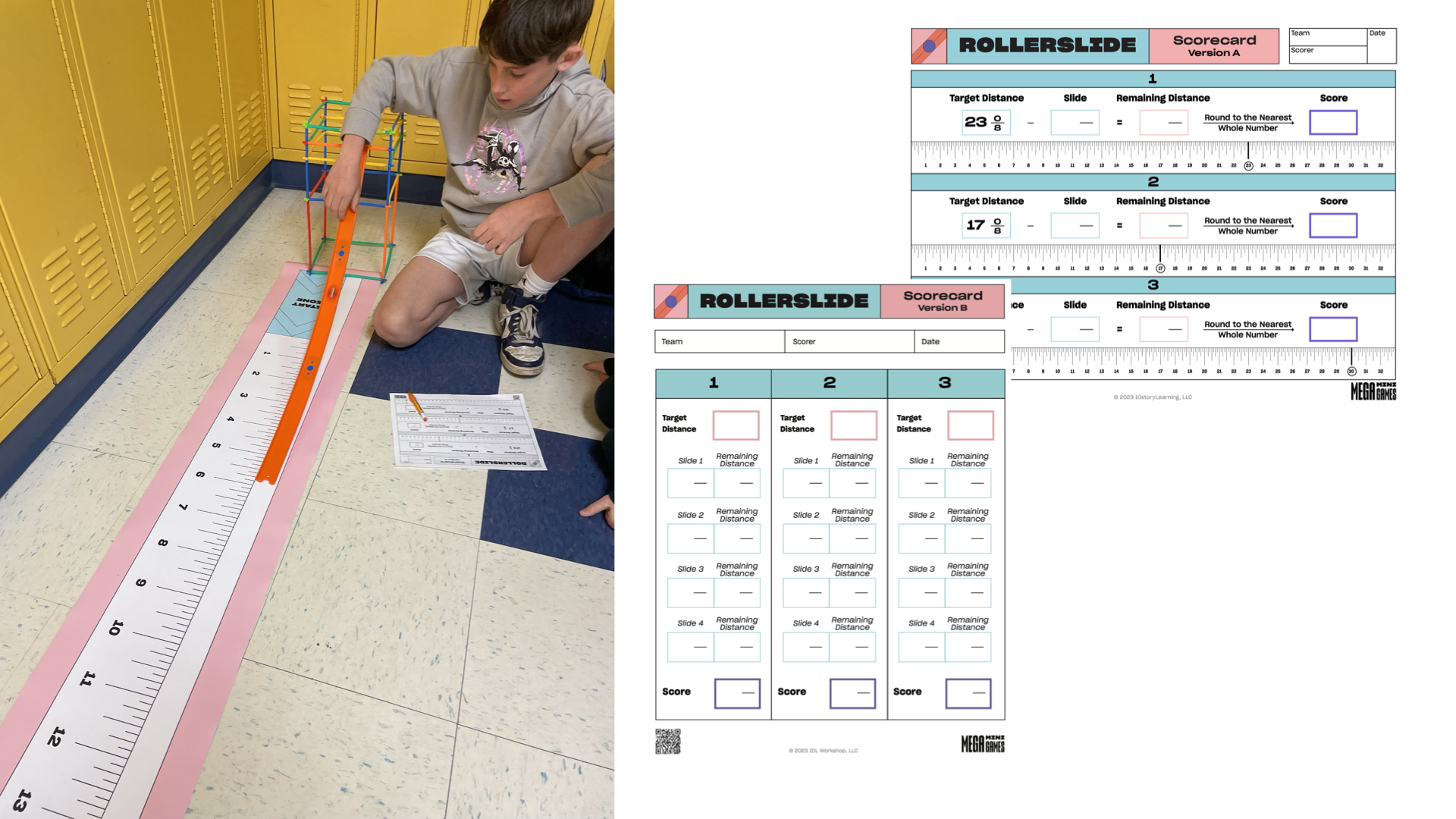
- Rollerslide mats (200 cm polypropylene tracks)
- Collision game boards (33″×22″, printed on both sides)
- Apex mats (55″ polypropylene tracks)
- Hot Wheels tracks and connectors
- Marbles, curling pucks, bean bags, and ping pong balls
- Connector straws and craft materials for game design
- Player's guides, planners, jobs poster, and teamwork poster
- Quick-reference teacher booklet
How it runs in the classroom
Every session runs through a web-based slide portal. Each session opens with the day's challenge and team setup, then moves into the hands-on activity. Short visual mini-lessons teach the math students need to do the work, narrated by veteran math educator Howie Templer.
Sessions run 45–90 minutes, with some extending longer at the teacher's discretion. The curriculum works as a daily block (3–4 weeks), a twice-weekly enrichment (5–10 weeks), or an afterschool/summer program. It supplements any core curriculum — students learn fraction operations through their regular instruction, and The Next Big Game is where they apply those concepts with physical materials and collaborative problem-solving.
Open the kit, follow the slides, and go.
Standards by session
The Next Big Game covers equivalent fractions, adding and subtracting fractions with like and unlike denominators, multiplying fractions, and dividing fractions — standards already in your grade 5 scope. It doesn't replace your core instruction on these topics. It gives students a place to apply what you're already teaching, using physical materials and collaborative problem-solving.
| # | What students do | Standards |
|---|---|---|
| 1 | Make a meter stick — equivalent fractions; fraction of a whole | 4.NF.A.1 |
| 2 | Play Mini Games — add & subtract fractions with like denominators | 4.NF.B.3 |
| 3 | Play Rollerslide — add & subtract fractions with unlike denominators | 5.NF.A.1 |
| 4 | Play Collision — multiply fractions | 5.NF.B.4 |
| 5 | Play Apex — divide fractions | 5.NF.B.7 |
| 6–9 | Design, build & test advanced fraction games | 4.NF–5.NF |
| 10 | Game Expo — present, play & evaluate games | 4.NF–5.NF |
Professional development
PD is optional. The teaching portal provides step-by-step guidance for every session, and most teachers run The Next Big Game successfully from the slides alone. PD is recommended when you want to deepen teaching practice around hands-on facilitation, or when a department or grade-level team is adopting the lab together.
Professional development focuses on teaching practice — structuring hands-on learning, facilitating collaborative problem-solving, and reading student thinking during open-ended design work. Led by a nationally recognized math educator, teachers work through a Next Big Game session as learners — rolling marbles down Rollerslide ramps, flicking pucks across Collision boards, scoring with fraction operations. Then they unpack the teaching moves with the facilitator: how to structure the teamwork, where students get stuck, what questions to ask, when to step back.
Format & details
- Half-day workshop, up to 30 participants
- $3,495 flat fee
- Led by a nationally recognized math educator
- Teachers experience a full lab session as learners, then unpack the pedagogy
- Fundable through Title II-A professional development funds
- Available as a follow-up coaching package for ongoing implementation support
Evaluation partnership
For districts running formal evaluation studies. If your research office, grant funder, or district evaluation requirements call for a structured study of program impact, we partner with you to design one. If you're a classroom teacher, you don't need any of this to run The Next Big Game — this section is for evaluation directors, research partners, and grant compliance.
Structure a rigorous study using your own assessments, your own comparison groups, and your own timeline. We don't sell the data — your district owns the results and is free to publish.
Research design options
Simple pre/post
Administer a brief assessment before and after the lab, using district benchmark questions or the 10story pre/post instrument.
Delayed-start RCT
Half of participating classrooms begin first, the other half a few weeks later. Assess all students after the first group completes the project. Use a 10story pre/post or your own assessment.
Matched comparison
Compare participating classrooms to non-participating classrooms with similar demographics and prior achievement.
Implementation + perception study
Document implementation fidelity, student engagement, and teacher perception alongside quantitative measures.
Kit
Teams of 4 students. The Full Kit serves a single classroom.
Full Kit
Materials for a full classroom of 7 Next Big Game teams.
- 7 team material packs
- Rollerslide mats, Collision boards, and Apex mats
- Marbles, curling pucks, bean bags, ping pong balls, and dice
- Hot Wheels tracks and connectors
- Connector straws and craft materials for game design
- Player's guides, planners, posters, and teacher portal access
Year over year
The Next Big Game kit includes both durable components (Rollerslide mats, Collision boards, Apex mats, marbles, curling pucks, bean bags, Hot Wheels tracks) and consumable design materials (planners, scorecards, construction paper, glue sticks, tape). Each new class needs a fresh kit to ensure students have the design and build materials they need. Most districts budget The Next Big Game as an annual line item.
Funding
Schools and districts commonly fund The Next Big Game through:
- Title I (supplemental support for under-served students)
- Title IV-A (Student Support and Academic Enrichment)
- ESSER carryovers, where still available
- 21st Century Community Learning Centers (afterschool and summer)
- Foundation STEM grants
- PTO/PTA budgets for classroom enrichment
Quantity discounts are available for multi-classroom orders. Ask us for a quote.